

"This whole world is wild at heart and weird on top..." – David Lynch
Though I would like to say my first experience with the films of David Lynch was a midnight screening of the neo-murder-mystery Blue Velvet in a dingy arthouse theater in the mid-to-late 80s during the independent film boom sitting next to a sleazy femme fatale… I’d be lying.
Actually, my Lynch fandom began at the Scholastic Book Fair around ’85. I purchased a four-pack of film storybooks, including Supergirl, Return to Oz, and Indiana Jones and the Temple of Doom, all movies I had viewed many times and had great respect for.

But, there was one book/film that I had never heard of…it was The Dune Storybook, by Joan D. Vinge, based on the movie Dune by David Lynch, which was based on the novel by Frank Herbert.
The book was a tenuous adaptation that, obviously, was not very child friendly, but I was mesmerized with it. That started a rabbit-hole that turned me into a 7-year-old Lynch completist, seeing all of his movies in the theater, his television shows on the tube, and later, his albums of esoteric recordings that went under the radar.

Sadly, Lynch died last year and, for the most part, I felt sections of my soul tear into well-worn pieces of heartbreaking tin foil and depressing chicken wire enough to curate the most depressing art piece of all-time.
That’s when I stopped dreaming in cathode rays and white noise...
But over the past few months, I started to find his static creations in odd places, like cherry pie on an empty counter. It made me realize that maybe there are other outsiders—those creepy weirdos, like myself—that felt that electric loss in the known universe and look for that garbonozia that’s now sorely missing.

I think I found a little piece of that in Norman last week at the Uncanny Art House, 106 E. Main St., and their new exhibit, In Dreams: A David Lynch Tribute Exhibition, running until March 1st.
It’s an all-immersive immersion into the world of the pervasive creator, with artists giving their impressions of the man and his work, drawing inspiration from films like Eraserhead, Blue Velvet, or Lost Highway, and exploring the way his work has influenced them.

Once past the combination lobby and gift shop and into the dark, the exhibition starts with visual art representations of Lynch’s many motifs such as cherry pies and cigarette butts. More than fifty artists—including Twin Peaks cast member, Michael Horse—are realized in this space, with a wall of many of their impressions, ranging from the concrete to the fantastic.
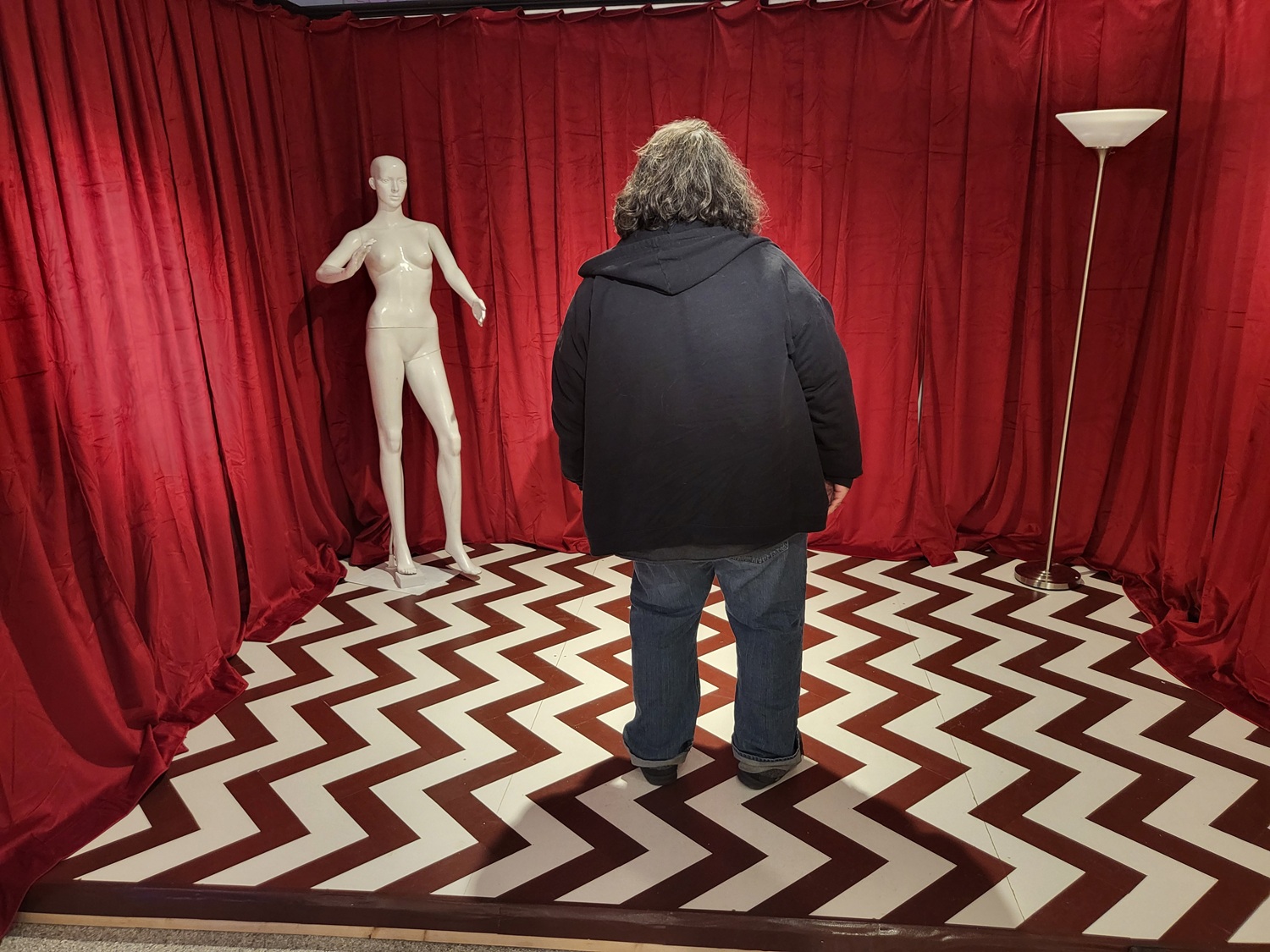
In the midst of the obligatory paintings and drawings, there were bizarre sculptures and weird dioramas that almost felt like scenes in his films, giving graphic 4-D representation of black bunny ears from Inland Empire, a recreation of the Black Lodge from Twin Peaks and, all too real, the asthmatic, mewing and surreal baby from Henry’s loins in Eraserhead.

But the one thing that really brought me out on a chilly Saturday afternoon was the call of Roy Orbison’s melodic cacophony under flickering fluorescent lights as we were taken asunder in the Nez Perce retellings of said Lodge, waging a near-ending war of the light and the dark.
And, besides, it really felt cool.

Though most of his films were visually realized—I didn’t see any Dune artwork, but I’ll let it slide—TV screens were also playing his films on rotation in front of an oddly misshapen couch. As the dark room with the moving images transfixed me, for a second, I felt Lynch’s spirit enveloped me, taking out all my Bob-rage and turning it into an angelic seraph that will heal my broken heart.
In the end, the art of Lynch will always stay with me. With black celebrations like the In Dreams exhibition, it will not only seem that I wasn’t alone in the fandom, but there are more of us than I really expected.
Tonight, I think I will watch Dune again and sniff some spice melange in tribute.

-
Follow Louis Fowler on Instagram at @louisfowler78.


