


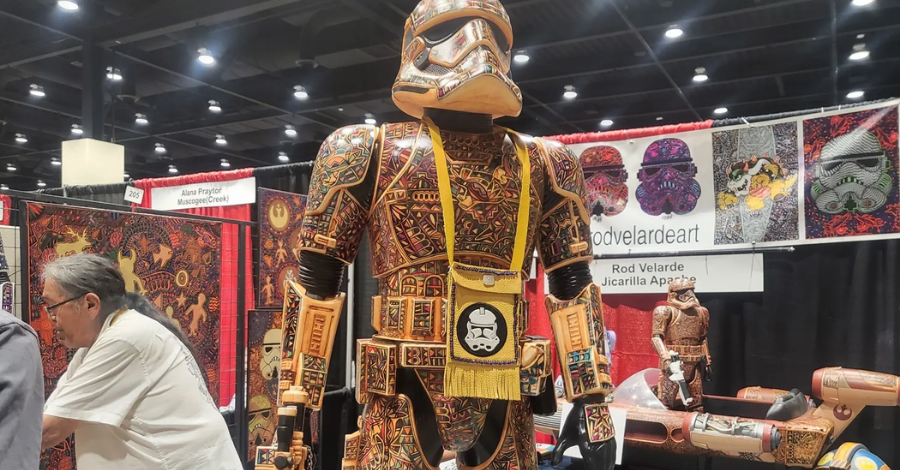
I first attended the Red Earth Festival in the early 90s, a kid who was unsure of his own Indigenous identity.
In my middle and high school years, I was a part of a Native American student group that worked on culturally relevant service projects, created and wrote anti-drug skits, and, of course, fundraised with hot dogs during community festivals—one of which was Red Earth.
Reminiscing about my time with the group and the seeds of dissent I planted there, I always enjoyed attending Red Earth, learning more about my heritage, my lineage, and that true identity I had been searching for.
The years and the strokes stacked up.
Thirty years later, as a grown man comfortable in my roots, I returned to the two-day festival, now in its 40th year and fittingly themed “Coming Home.”
For the uninitiated, Red Earth is one of the premier Native art markets in the country, where the art extends beyond the booths to traditional dance competitions, film and media screenings, and Indigenous musical performances—a celebration of a thriving Native culture.
I arrived around 1:00 p.m. and picked up my press pass at the will call table. As the mighty beat of the Thunderboy Family Dance Troupe shook the foundations of the place, I walked into a world that was both familiar and changed and got reacquainted.
It didn’t take long.
Walking the aisles of Indigenous art—from the new wave work of a classically trained painter marking his territory, to the clanging-steel and marching-feet soundtrack of the pop culture fashions—I witnessed an old story being told anew.
A smile crept across my face as I watched Native artisans proudly share their work with the eager wanderers. Some sketched new pieces at their tables between customers, while jewelry makers and traditional bead artists presented their gorgeous wares to the admiring public.
Witnessing the full spectrum of the Indigenous community together at Red Earth was medicine for my wretched soul. Between the stalls I saw members of true Native royalty, dismantlers of systemic oppression, and reminders of a struggle that is far from over. It felt damn good.
While my wife was in line desperately swooning over a beaded bracelet to complete her ensemble, I walked over and decided to try the Indigenous tacos being sold at the event.
Though the frybread was much thinner than I liked, a frybread taco is a frybread taco, so of course I downed the whole thing right there. With a comforting cup of pumpkin bread pudding for dessert, it was alright for a late lunch, and I appreciated the effort.
Hunger satisfied, I walked to the back part of the convention center, where the drummers were set up.
As I sat in the portable stands, I was taken aback at the sheer power and intensity of both the Next Generation White Buffalo Dance Group and the start of the Women’s Jingle Dress vs. the Fancy Shawl dance competition—a contest between Northern and Southern styles of Indigenous dancing traditions.
These drummers and dancers put on a show of unbridled passion and intensity, every whoop and holler sending surges of power through the sizable crowd. This was their culture, their history, their pain and their joy, poured out for the entire arena, leaving nothing left at the end.
It was in that moment, overcome with emotion and pride after 30 years away, that I realized I was back home. And I will never stay gone so long.
-
Follow Louis Fowler on Instagram at @louisfowler78.


